Quiver Tree Forest, Namibia
forest namibia Nature quiver treeThe Quiver Tree Forest is located about 14 km north-east of the town of Keetmanshoop, on the road to the small village of Koës, in southern Namibia. Here grows, on a private farm, about 250 specimens of the quiver tree, or aloe dichotoma, which is a tall, branching species of aloe, indigenous to the Northern Cape region of South Africa, and parts of Southern Namibia. The unusual look of aloe dichotoma has made this area a popular tourist attraction.
The quiver tree is not really a tree, rather a plant of the genus aloe, as evident from its scientific name, and one of the few species of aloe that reaches tree proportions —it can grow 7 to 9 meters high. It has a stout stem that may grow to one meter in diameter, and is covered with beautiful golden brown scales with sharp edges. The crown consist of numerous forked branches, which gives the species its name dichotoma, which means forked.

Photo credit: Njambi Ndiba/Flickr
At the tip of each branch is a spiral rosette of pointed, thickly-succulent leaves, typical of all aloe plants. Unlike the scaled trunk, the branches are smooth and are covered with a thin layer of whitish powder that helps to reflect the sun’s rays. Between June and August, which is wintertime in the Southern Hemisphere, bright yellow flowers bloom drawing both birds and human visitors.
The quiver tree is so named because native bushmen used to make quivers from the branches of the tree. Aloe dichotoma doesn't have real wood but a soft pulpy tissue, that can be hollowed out easily. One end of the hollow section is closed off with a piece of leather and used by the bushmen to hold arrows. The natives also used large hollowed out trunks to store food and water. The fibrous tissue of the trunk has a cooling effect as air passes through, allowing the natives to store perishables for longer durations.
Apart from their historical use by humans for arrow-quivers, these trees hold tremendous ecological value. Many insects, animals and birds are drawn to the abundant nectar of the flowers. The tree is also an important nesting site for huge numbers of sociable weavers. The bird build their nests among the branches, which offer the nestlings protection from high temperatures, as well as from predators.
The quiver tree is now classified as a vulnerable species. Its biggest threat is the globally rising temperature, and decreasing rainfall. But the species is fighting back by slowly shifting its distribution towards the cooler regions in higher latitudes and higher altitudes. The tree is protected by law in South Africa, and the Quiver Tree Forest is a national monument of Namibia.

Photo credit: Joachim Huber/Flickr

Photo credit: Joachim Huber/Flickr

Photo credit: Bobby Bradley/Flickr

Photo credit: Joachim Huber/Flickr

Photo credit: José Carlos Babo/Flickr
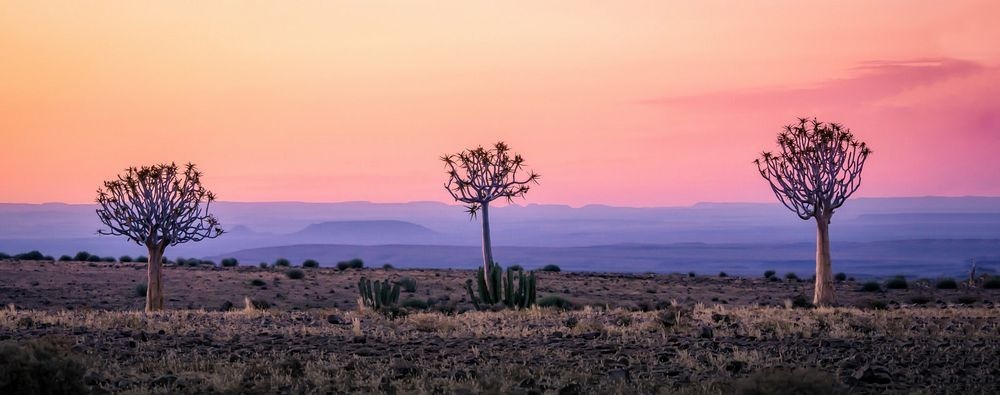
Photo credit: Curtis Simmons/Flickr
Sources: Wikipedia / Arkive / www.plantzafrica.com / h2g2.com
Subscribe to our Newsletter and get articles like this delieverd straight to your inbox
The quiver tree is not really a tree, rather a plant of the genus aloe, as evident from its scientific name, and one of the few species of aloe that reaches tree proportions —it can grow 7 to 9 meters high. It has a stout stem that may grow to one meter in diameter, and is covered with beautiful golden brown scales with sharp edges. The crown consist of numerous forked branches, which gives the species its name dichotoma, which means forked.
Photo credit: Njambi Ndiba/Flickr
At the tip of each branch is a spiral rosette of pointed, thickly-succulent leaves, typical of all aloe plants. Unlike the scaled trunk, the branches are smooth and are covered with a thin layer of whitish powder that helps to reflect the sun’s rays. Between June and August, which is wintertime in the Southern Hemisphere, bright yellow flowers bloom drawing both birds and human visitors.
The quiver tree is so named because native bushmen used to make quivers from the branches of the tree. Aloe dichotoma doesn't have real wood but a soft pulpy tissue, that can be hollowed out easily. One end of the hollow section is closed off with a piece of leather and used by the bushmen to hold arrows. The natives also used large hollowed out trunks to store food and water. The fibrous tissue of the trunk has a cooling effect as air passes through, allowing the natives to store perishables for longer durations.
Apart from their historical use by humans for arrow-quivers, these trees hold tremendous ecological value. Many insects, animals and birds are drawn to the abundant nectar of the flowers. The tree is also an important nesting site for huge numbers of sociable weavers. The bird build their nests among the branches, which offer the nestlings protection from high temperatures, as well as from predators.
The quiver tree is now classified as a vulnerable species. Its biggest threat is the globally rising temperature, and decreasing rainfall. But the species is fighting back by slowly shifting its distribution towards the cooler regions in higher latitudes and higher altitudes. The tree is protected by law in South Africa, and the Quiver Tree Forest is a national monument of Namibia.
Photo credit: Joachim Huber/Flickr
Photo credit: Joachim Huber/Flickr
Photo credit: Bobby Bradley/Flickr
Photo credit: Joachim Huber/Flickr
Photo credit: José Carlos Babo/Flickr
Photo credit: Curtis Simmons/Flickr
Sources: Wikipedia / Arkive / www.plantzafrica.com / h2g2.com
Subscribe to our Newsletter and get articles like this delieverd straight to your inbox


